I finally withdrew from my PhD today (probably many people thought that this had happened some time ago).
In the beginning…
The story really starts in 1999. I started working consistently while studying, and also got rather bored with the study that I was doing. I also got involved in the Students’ Association – first lightly, then pretty heavily. As a result, at the end of 2000, I was about 1.5 papers short of finishing my BSc and BBS. I needed to do half a semester of work, and so I decided to go those at the same time as a Postgraduate Diploma in Science (these went along with running for ASA President). The ASA job didn’t work out, but I did finish the last undergrad stuff I needed to do, and rather unexpectedly found that I really enjoyed the postgrad study.
I was able to do all the papers for the postgrad diploma along with the undergrad work, except for the double-paper research project, in that year. That meant that the next year started off with finishing off the research project – normally half of a semester’s load, but since I didn’t have anything else to be doing, I poured in a whole semester’s effort into it. That left me at the middle of the year with everything complete.
To be Dr T…
At this point, I was offered a $20k scholarship to do a PhD at Massey. A lot of thought went into this at the time – including a lot of talking with Olyvia (this was not that long before we got engaged). It was clearly going to be financially terrible for three years, but money has never been my focus. On the positive side, I was assured (and believed) that there was quite a lot of demand for lecturers, and I had found that I really enjoyed teaching, research, and administration, which are basically the three components of a (NZ) lecturing position. It seemed at the time like it was a good career choice (especially the flexibility that it offered), and so I took up the choice.
I chose to continue on with the work that I’d done for my research project (what I ended up calling synthetic actors). There were a lot of reasons that this was a good choice – it was AI, which I particularly enjoyed, it involved theatre, which I was spending a lot of time doing, and it was a very clear field (i.e. few other researchers in the area).
Early errors…
In retrospect, both of these were poor choices. I should never have enrolled with Massey to do a PhD. The Computer Science department at Albany is just a poor relation of the strong Maths/Statistics department, and so it’s not really a good choice, even though at the time (and possibly now) they had some really good staff. I should have gone somewhere where Computer Science was a department with real funding and support, and where I could potentially have got some work once I was done.
Although synthetic actors were fascinating and I got the work done (other than a bit of writing) in the end, it was a bad choice. For a start, a topic like this, which bridges disciplines, needs to be done somewhere where there is more history of cross-discipline study. To do a topic like this I should also have been somewhere that had a strong theatrical department (i.e. I really needed to be in Wellington). It’s really very important to pick a topic that matches the institution (or an institution that matches the topic).
The other problem with the topic, exacerbated by doing it at Massey, where there’s no history of this type of research, is that it is really hard to measure. Computer science is really a lot like mathematics and statistics in that what you’re typically after is something that you can do and collect numbers and then have some sort of graph that shows that things are improved. A semi-art topic like synthetic actors doesn’t suit that well at all. I ended up finding things to measure, but that did mean that a lot of the effort that the project needed (e.g. putting on the two productions) wasn’t central to the real research.
Somewhat ironically, a much more suitable topic was at hand a little later. I started working on SpamBayes, and a computer science/statistics project would have been a great fit with Massey and also very measurable. It would also have been much more translatable into work (in fact, my work on the project, outside of the PhD work, has contributed much more).
Good times…
Despite these two things, everything went pretty well for the first 2.5 years. Money, as expected, was pretty tight – $20k is not a lot, especially with a wedding and living a ‘grown up’ life (i.e. not poor student flatting or living at home with parents). In fact, our rent was about $20k at this time. This meant that I had to work a lot as well as study full time, but even though I had little spare time, I was enjoying both, so it seemed ok. The English department at Massey was hugely helpful here, because they paid me decent wages to teach a paper each semester (whereas in Computer Science you got less than working at a service station).
Towards the end of the three-year period, everything was basically on track. I had about a third to a half of my thesis complete (about half of this was later rewritten from scratch) with about 6 months to go. My plan was that I would spend a reasonable amount of time time looking for (lecturing) work to move into as I finished up the thesis – I even gave up the lucrative English teaching in order to do this.
Stalling…
This is where everything stalled. I vastly underestimated how difficult finding lecturing work would be (and how unhelpful and insulting Massey would be). With a couple of months of stipend to go, I disparately needed to find work (Olyvia wasn’t working at this time either, so the need was particularly urgent). Although there wasn’t any lecturing work to be found (or at least, anyone interested in me), there was a lot of other work.
In particular, SpamExperts approached me about doing a short project (nearly 5 years later, I’m still working for them!), Lifeway College approached me about teaching a module (in Business Modelling with Spreadsheets, of all things), and Northtec (indirectly) approached me about filling in for a few weeks (I’m still doing this – and another paper – too) for a programming paper.
All of this was enough to pay the bills, but combined with still looking for lecturing work, left me no time to actually finish off the thesis. The two teaching jobs in particular (which I valued a lot because they seemed like good experience for lecturing work) required me to create the courses from scratch (and I had to learn Business Modelling, since I had no prior knowledge). Several months passed without any thesis work getting done.
This was really my biggest error – underestimating how difficult it would be to get work afterwards. I should have come up with some plan that wouldn’t have resulting in losing the last (essential) few months of full-time study that I had. I’m not sure what that plan would have been, but it was what was missing.
Stuck…
The plan around this time was that we’d have our first child during the next year – we didn’t want to be old parents (and if we have two children want to have a break between them), and it seemed like a good time (with me going into the real work force and so on). Samuel came along very quickly (planning’s fine, but there’s still some luck involved) – I rather naively assumed that finishing the PhD and working would fit into the pregnancy year without any problem (after all, it was Olyvia that was pregnant, not me, right?).
I probably could have managed to get work done during that time. However, I was enjoying a break of just normal working life, I was working a lot of hours (I had many jobs, but all were – in theory – temporary, so I was scared that they’d end and I’d have nothing, so I needed savings). Finally, supporting Olyvia during the pregnancy took a lot more time that I expected, with antenatal classes, midwife visits, scans, shopping, and so forth. I could have skipped this, of course, but they took priority for me over the PhD.
Limbo #1
Once Samuel really arrived (28/8/6), there really was no time to spare. The first year, in particular, was quite tricky, and I spent all my time parenting and working. If I had put thesis work into the mix, I would have produced rubbish or would have burnt out. A year or so later, things did start to quieten down a bit, but I was in an odd limbo where I had had such a long break that I wasn’t sure where I was.
Going back to the work after a long break was difficult, and since I’d used up the 4 years I was meant to have, I wasn’t sure whether the work would be accepted anyway. Massey was extremely unhelpful here (not my supervisor – he was great), in that I was continually asking for time and never hearing about whether I was granted it or not – the only time I heard from them was the ridiculous requests for 6-monthly reports and queries about when it would be done.
(The reports infuriate me. In theory, they’re meant to track how people are going. However, I submitted years of reports saying “I failed to get anything done”, and nothing came of them. So obviously they are ignored, and are pointless. I could have spent the time actually getting work done instead).
I had about a year of this limbo. This was the second big mistake, really. I could have managed to get the work complete during this time – I was busy with work and parenting, sure, but there was also a bit of time here and there where I could have knuckled down and got the work done without going crazy. The PhD seemed very distant and less and less important as time progressed and so motivation was very difficult.
Nearly unbelievably, progress again…
About 18 months ago, the limbo finally ended. I finally got some clear answers (thanks to my supervisor I believe) from Massey about whether I was able to continue working on it or not. The original plan was to finish the thesis (other than some editing) by the end of 2008. I made a private plan with my supervisor to get a certain number of words done every week (emailing fresh copies weekly) and if I failed to get that done any week, I’d withdraw. I worked very hard at this, and although it was tricky, I did manage to meet each deadline.
At the end of the year, I was a little short (about 1.5 chapters and a bit of tidying up), although I’d done more editing than originally planned. Limbo came back. Eventually (some time in early 2009) I did hear that I had an official (after years!) extension until 29/11/09. This was clearly enough time, at least in theory.
Limbo #2
However, the last 12 months have been a disaster for me personally. 2009, without doubt, has been the worst year of my life so far (hopefully, ever). I had no idea that things could go so badly. The details don’t really belong here, but I honestly don’t believe that I had any chance to get the work done (to an acceptable standard) this year. I really needed to get it done the previous year (when in honesty I should have been able to find time) – there was just no way I could work on it this year.
The end
Supposedly Massey have been trying to talk to me about the status recently (I don’t know for how long) and haven’t been able to get hold of me. I find this difficult to believe considering how easily an email address for me (or even this blog!) can be found via Google. Olyvia got a message on the phone today querying the status (predictable given that the deadline is 9 days away), and I sent the IIMS HoD a message indicating that I was withdrawing (in reality, there’s no choice – and if I’d known what the year would be like, I would have just done that a year ago).
Retrospective thoughts
This is obviously disappointing. The PhD was the biggest project I’d worked on at the time, and I poured a lot of time, money, and effort into it. It’s also nearly done – I have tens of thousands of words of a thesis complete. It’s frustrating quitting something when it’s so close to completion.
I’ve also always been mindful of the support that others gave me, particularly in those first three (productive, active) years. Olyvia, Mum and Dad, Jacs, Jo, Geoff and the other MADSODS, Chris, Jenny, and so forth. It always seemed like I owed it to them to complete the damn thing as well.
However, it has been hanging on my neck like the proverbial millstone for years now. Few days go by without at least one guilty stressful thought about how I haven’t done anything towards it that day. It will be nice to leave that behind.
In reality, there’s no practical benefit to getting the PhD. I long since lost any desire to work in academia (thanks, Massey!), and even if I got the PhD, I’ve spent too many years without getting anything published to be a strong candidate for any job (I was a stronger candidate, in many ways, back when I failed to find lecturing work years ago). In NZ, which is where I want to continue working, there’s little career value to a PhD outside of academia. I still have plenty of work (although the exchange rate is hurting a lot) and I’m certain that I could find more if I had to (although I’ve clearly been wrong about that before!).
On the other side of the equation, there are things that really are important to me. In particular, family. If given the choice between spending more time with Samuel and writing a thesis that’s only of sentimental worth, I’ll pick Samuel without any regrets.
Looking back, I can see where I made mistakes – the poor topic choice, failing to see how difficult finding work would be, not utilising time in 2007/8. However, I don’t regret any of the decisions I made at the time. Most of the time, I was choosing things that are still more important to me than the PhD.
To those reading this that did help – thanks. I really do wholeheartedly appreciate all the support. Also: my apologies – I’m sorry if I have let you down by not completing everything. I hope you understand that there are just things that are more important to me (I know some people do, since they’ve said that to me in the past – Dad did this a while ago).
So that’s that. I’ll probably put the thesis up at some point – maybe another eager kid will want to work with synthetic actors (despite Claudio giving it up and then me giving it up) and will find it useful. I might have more thoughts then. For now, I’m going to go back to things that I care more about.
p.s. Yes, I did partly choose the title of this post to counter the Google juice that the James Bond Tony Meyer seems to have.

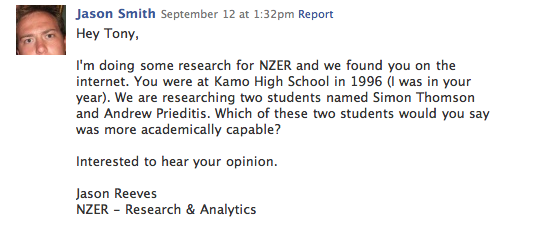 I received this rather odd message the other day (Facebook is a truly strange system).
 TonyAndrewMeyer