Latest MySky (HDi) update

The latest (and heavily publicised) MySKY (HDi only?) update was released today.  Oddly, our update was applied around 2 p.m. – the currently showing program was replaced by a very ugly notice that the system was being updated.  I can’t understand why the update wasn’t deployed during the night (e.g. 4 a.m.), when the number of viewers must be significantly lower.  What if I had really cared about the program that was showing?

My initial reaction was very negative.  After it was pointed out (via Twitter) that many of SkyTV’s mistakes are correctable via new options in the settings back, I’m slightly less negative, but it’s still not an improvement.  This is especially frustrating considering that the UI is so terrible, and has been ever since MySKY was introduced about five years ago (I’ve had MySKY since just after the launch).  Being told that they know about the many problems and fixing them isn’t possible until the hardware is revved doesn’t inspire any confidence at all, since the problems existed with the original MySKY and certainly were not fixed when the hardware was revved (with HDi).  Someone at SkyTV is responsible for selecting the hardware – if the platform doesn’t support creating a decent UI, then they should choose something else.

(Has anyone on the MySKY team used an Apple product?  Or even Windows 7 or a Zune product?  Would they recognise good UI when they saw it?  Do they have anyone that has any UI talent or experience?  If so, perhaps they could give that person a bit of power to fix things?)

The “what’s new” page has a feedback form where you can comment on the recent changes.  I encourage you to do so.  My comments were:

Planner Search

Sorting by time is a pointless way to organise the planner – it caters to people that don’t understand how to use a DVR properly (e.g. who are using it like they would have used a VCR). Sorting by A-Z is vastly more useful, because the typical planner task is either finding a specific program to watch (I always know the first letter of the name, I rarely know or care when it was broadcast/recorded), or browsing through programs to find something to watch (I don’t care what’s oldest/newest, I care what the program is).

The changes in this update make things worse in this respect. Although it’s possible to turn off the video and set the “search” interface to A-Z sort by default, you’re then in an interface where you have to go right/left to get to delete/keep. The planner should default to A-Z search, or at least have that as an option.

Confirm Delete

Although it’s fantastic that after 5 years the “tiny button right next to ‘don’t delete this’ deletes irrevocably” problem has been addressed, a confirmation dialog is (although common) generally the wrong UI decision to make. Users (a) get into habits of just ok’ing such dialogs, decreasing their value, and (b) are less willing to try things out. It is almost always better (and certainly would be here) to simply make any action reversible (i.e. have an undo delete).

Preview

The preview in search seems completely pointless. I almost certainly know what the program is based on the title, and if I don’t, then starting to show the program isn’t going to help. This is exacerbated by the fact that with the “automatic” buffer setting the preview generally starts with the end of the program that was on before the program that you’re looking at.

It *would* be useful to have an episode name & number (where applicable) in the main planner screen (e.g. to distinguish between several episodes of a kid’s program that is played out-of-order), or to only show each series once (and selecting it goes into a submenu where specific episodes can be selected; this is common in other interfaces where screen space is limited). Showing the synopsis in search helps with this, but takes up a vast amount of space (only five rows of text – even on a huge screen!), and comes with the annoying and loud video.

Positive

After five years, the guide finally shows an indication of which programs are scheduled to be recorded.  This feature was present in the old Sky Digital system (which didn’t record, but did allow you to schedule reminders), and it’s amazing that it’s taken this long to restore it.  However, it ignores series-link, so it only highlights the next episode.  It would be nice to get the feature right.

Dr? No.

I finally withdrew from my PhD today (probably many people thought that this had happened some time ago).

In the beginning…

The story really starts in 1999.  I started working consistently while studying, and also got rather bored with the study that I was doing.  I also got involved in the Students’ Association – first lightly, then pretty heavily.  As a result, at the end of 2000, I was about 1.5 papers short of finishing my BSc and BBS.  I needed to do half a semester of work, and so I decided to go those at the same time as a Postgraduate Diploma in Science (these went along with running for ASA President).  The ASA job didn’t work out, but I did finish the last undergrad stuff I needed to do, and rather unexpectedly found that I really enjoyed the postgrad study.

I was able to do all the papers for the postgrad diploma along with the undergrad work, except for the double-paper research project, in that year.  That meant that the next year started off with finishing off the research project – normally half of a semester’s load, but since I didn’t have anything else to be doing, I poured in a whole semester’s effort into it.  That left me at the middle of the year with everything complete.

To be Dr T…

At this point, I was offered a $20k scholarship to do a PhD at Massey.  A lot of thought went into this at the time – including a lot of talking with Olyvia (this was not that long before we got engaged).  It was clearly going to be financially terrible for three years, but money has never been my focus.  On the positive side, I was assured (and believed) that there was quite a lot of demand for lecturers, and I had found that I really enjoyed teaching, research, and administration, which are basically the three components of a (NZ) lecturing position.  It seemed at the time like it was a good career choice (especially the flexibility that it offered), and so I took up the choice.

I chose to continue on with the work that I’d done for my research project (what I ended up calling synthetic actors).  There were a lot of reasons that this was a good choice – it was AI, which I particularly enjoyed, it involved theatre, which I was spending a lot of time doing, and it was a very clear field (i.e. few other researchers in the area).

Early errors…

In retrospect, both of these were poor choices.  I should never have enrolled with Massey to do a PhD.  The Computer Science department at Albany is just a poor relation of the strong Maths/Statistics department, and so it’s not really a good choice, even though at the time (and possibly now) they had some really good staff.  I should have gone somewhere where Computer Science was a department with real funding and support, and where I could potentially have got some work once I was done.

Although synthetic actors were fascinating and I got the work done (other than a bit of writing) in the end, it was a bad choice.  For a start, a topic like this, which bridges disciplines, needs to be done somewhere where there is more history of cross-discipline study.  To do a topic like this I should also have been somewhere that had a strong theatrical department (i.e. I really needed to be in Wellington).  It’s really very important to pick a topic that matches the institution (or an institution that matches the topic).

The other problem with the topic, exacerbated by doing it at Massey, where there’s no history of this type of research, is that it is really hard to measure.  Computer science is really a lot like mathematics and statistics in that what you’re typically after is something that you can do and collect numbers and then have some sort of graph that shows that things are improved.  A semi-art topic like synthetic actors doesn’t suit that well at all.  I ended up finding things to measure, but that did mean that a lot of the effort that the project needed (e.g. putting on the two productions) wasn’t central to the real research.

Somewhat ironically, a much more suitable topic was at hand a little later.  I started working on SpamBayes, and a computer science/statistics project would have been a great fit with Massey and also very measurable.  It would also have been much more translatable into work (in fact, my work on the project, outside of the PhD work, has contributed much more).

Good times…

Despite these two things, everything went pretty well for the first 2.5 years.  Money, as expected, was pretty tight – $20k is not a lot, especially with a wedding and living a ‘grown up’ life (i.e. not poor student flatting or living at home with parents).  In fact, our rent was about $20k at this time.  This meant that I had to work a lot as well as study full time, but even though I had little spare time, I was enjoying both, so it seemed ok.  The English department at Massey was hugely helpful here, because they paid me decent wages to teach a paper each semester (whereas in Computer Science you got less than working at a service station).

Towards the end of the three-year period, everything was basically on track.  I had about a third to a half of my thesis complete (about half of this was later rewritten from scratch) with about 6 months to go.  My plan was that I would spend a reasonable amount of time time looking for (lecturing) work to move into as I finished up the thesis – I even gave up the lucrative English teaching in order to do this.

Stalling…

This is where everything stalled.  I vastly underestimated how difficult finding lecturing work would be (and how unhelpful and insulting Massey would be).  With a couple of months of stipend to go, I disparately needed to find work (Olyvia wasn’t working at this time either, so the need was particularly urgent).  Although there wasn’t any lecturing work to be found (or at least, anyone interested in me), there was a lot of other work.

In particular, SpamExperts approached me about doing a short project (nearly 5 years later, I’m still working for them!), Lifeway College approached me about teaching a module (in Business Modelling with Spreadsheets, of all things), and Northtec (indirectly) approached me about filling in for a few weeks (I’m still doing this – and another paper – too) for a programming paper.

All of this was enough to pay the bills, but combined with still looking for lecturing work, left me no time to actually finish off the thesis.  The two teaching jobs in particular (which I valued a lot because they seemed like good experience for lecturing work) required me to create the courses from scratch (and I had to learn Business Modelling, since I had no prior knowledge).  Several months passed without any thesis work getting done.

This was really my biggest error – underestimating how difficult it would be to get work afterwards.  I should have come up with some plan that wouldn’t have resulting in losing the last (essential) few months of full-time study that I had.  I’m not sure what that plan would have been, but it was what was missing.

Stuck…

The plan around this time was that we’d have our first child during the next year – we didn’t want to be old parents (and if we have two children want to have a break between them), and it seemed like a good time (with me going into the real work force and so on).  Samuel came along very quickly (planning’s fine, but there’s still some luck involved) – I rather naively assumed that finishing the PhD and working would fit into the pregnancy year without any problem (after all, it was Olyvia that was pregnant, not me, right?).

I probably could have managed to get work done during that time.  However, I was enjoying a break of just normal working life, I was working a lot of hours (I had many jobs, but all were – in theory – temporary, so I was scared that they’d end and I’d have nothing, so I needed savings).  Finally, supporting Olyvia during the pregnancy took a lot more time that I expected, with antenatal classes, midwife visits, scans, shopping, and so forth.  I could have skipped this, of course, but they took priority for me over the PhD.

Limbo #1

Once Samuel really arrived (28/8/6), there really was no time to spare.  The first year, in particular, was quite tricky, and I spent all my time parenting and working.  If I had put thesis work into the mix, I would have produced rubbish or would have burnt out.  A year or so later, things did start to quieten down a bit, but I was in an odd limbo where I had had such a long break that I wasn’t sure where I was.

Going back to the work after a long break was difficult, and since I’d used up the 4 years I was meant to have, I wasn’t sure whether the work would be accepted anyway.  Massey was extremely unhelpful here (not my supervisor – he was great), in that I was continually asking for time and never hearing about whether I was granted it or not – the only time I heard from them was the ridiculous requests for 6-monthly reports and queries about when it would be done.

(The reports infuriate me.  In theory, they’re meant to track how people are going.  However, I submitted years of reports saying “I failed to get anything done”, and nothing came of them.  So obviously they are ignored, and are pointless.  I could have spent the time actually getting work done instead).

I had about a year of this limbo.  This was the second big mistake, really.  I could have managed to get the work complete during this time – I was busy with work and parenting, sure, but there was also a bit of time here and there where I could have knuckled down and got the work done without going crazy.  The PhD seemed very distant and less and less important as time progressed and so motivation was very difficult.

Nearly unbelievably, progress again…

About 18 months ago, the limbo finally ended.  I finally got some clear answers (thanks to my supervisor I believe) from Massey about whether I was able to continue working on it or not.  The original plan was to finish the thesis (other than some editing) by the end of 2008.  I made a private plan with my supervisor to get a certain number of words done every week (emailing fresh copies weekly) and if I failed to get that done any week, I’d withdraw.  I worked very hard at this, and although it was tricky, I did manage to meet each deadline.

At the end of the year, I was a little short (about 1.5 chapters and a bit of tidying up), although I’d done more editing than originally planned.  Limbo came back.  Eventually (some time in early 2009) I did hear that I had an official (after years!) extension until 29/11/09.  This was clearly enough time, at least in theory.

Limbo #2

However, the last 12 months have been a disaster for me personally.  2009, without doubt, has been the worst year of my life so far (hopefully, ever).  I had no idea that things could go so badly.  The details don’t really belong here, but I honestly don’t believe that I had any chance to get the work done (to an acceptable standard) this year.  I really needed to get it done the previous year (when in honesty I should have been able to find time) – there was just no way I could work on it this year.

The end

Supposedly Massey have been trying to talk to me about the status recently (I don’t know for how long) and haven’t been able to get hold of me.  I find this difficult to believe considering how easily an email address for me (or even this blog!) can be found via Google.  Olyvia got a message on the phone today querying the status (predictable given that the deadline is 9 days away), and I sent the IIMS HoD a message indicating that I was withdrawing (in reality, there’s no choice – and if I’d known what the year would be like, I would have just done that a year ago).

Retrospective thoughts

This is obviously disappointing.  The PhD was the biggest project I’d worked on at the time, and I poured a lot of time, money, and effort into it.  It’s also nearly done – I have tens of thousands of words of a thesis complete.  It’s frustrating quitting something when it’s so close to completion.

I’ve also always been mindful of the support that others gave me, particularly in those first three (productive, active) years.  Olyvia, Mum and Dad, Jacs, Jo, Geoff and the other MADSODS, Chris, Jenny, and so forth.  It always seemed like I owed it to them to complete the damn thing as well.

However, it has been hanging on my neck like the proverbial millstone for years now.  Few days go by without at least one guilty stressful thought about how I haven’t done anything towards it that day.  It will be nice to leave that behind.

In reality, there’s no practical benefit to getting the PhD.  I long since lost any desire to work in academia (thanks, Massey!), and even if I got the PhD, I’ve spent too many years without getting anything published to be a strong candidate for any job (I was a stronger candidate, in many ways, back when I failed to find lecturing work years ago).  In NZ, which is where I want to continue working, there’s little career value to a PhD outside of academia.  I still have plenty of work (although the exchange rate is hurting a lot) and I’m certain that I could find more if I had to (although I’ve clearly been wrong about that before!).

On the other side of the equation, there are things that really are important to me.  In particular, family.  If given the choice between spending more time with Samuel and writing a thesis that’s only of sentimental worth, I’ll pick Samuel without any regrets.

Looking back, I can see where I made mistakes – the poor topic choice, failing to see how difficult finding work would be, not utilising time in 2007/8.  However, I don’t regret any of the decisions I made at the time.  Most of the time, I was choosing things that are still more important to me than the PhD.

To those reading this that did help – thanks.  I really do wholeheartedly appreciate all the support.  Also: my apologies – I’m sorry if I have let you down by not completing everything.  I hope you understand that there are just things that are more important to me (I know some people do, since they’ve said that to me in the past – Dad did this a while ago).

So that’s that.  I’ll probably put the thesis up at some point – maybe another eager kid will want to work with synthetic actors (despite Claudio giving it up and then me giving it up) and will find it useful.  I might have more thoughts then.  For now, I’m going to go back to things that I care more about.

p.s. Yes, I did partly choose the title of this post to counter the Google juice that the James Bond Tony Meyer seems to have.

Google Voice? Who really cares?

I really enjoy listening to Jason Calacanis when he’s on TWiT, and I think he generally makes a lot of sense (and considering his success, he clearly knows more than me).  However, his anti-Apple rant (like so many others) is really off-base (I’m not the only one that thinks so).

There is no technical reason why the iTunes ecosystem shouldn’t allow the ability to sync with any MP3 player

The iTunes ecosystem does allow the ability to sync with any MP3 player (even more so now that music is DRM-free).  You can build an application that uses the XML library description that iTunes creates to figure out where all the music/video is, and do what you like with it.  The way I see it, there’s no reason that iTunes/Apple should be forced to support any MP3 player with their software.  Apple clearly makes some money from the iTunes music/video sales, but it’s clearly not the main profit generator is the ecosystem – the high-margin iPods/iPhones are.  Apple has spent a great deal of time and money building a store and an application to make the players more appealing.  Why should any other player get to piggyback on the top of that?  If (e.g.) Palm wants to create an online music store and develop an application that works with it and the Pre, then they should be able to (and I see no reason they can’t).

I like iTunes more than other media applications I’ve used, but it’s certainly not perfect, and it shows that it started out as a music player and is now a great deal more.  I love the iTunes Store, but Amazon completes with it (I can’t tell how well, since they won’t see to me in NZ) as does the Zune Store – which even offers a subscription model (no idea if this is available in NZ – it’s too Windows-centric for me).  There’s absolutely room for someone (e.g. Palm) to build a better store (or interface with an existing one like Amazon) and built a better application.  Do that, and build a better device, and you’ll get customers.  Don’t expect that Apple should have to help you compete against them.

Think for a moment about what your reaction would be if Microsoft made the Zune the only MP3 player compatible with Windows.

The iPod/iPhone isn’t the only MP3 player compatible with OS X.  However, isn’t the Zune is the only MP3 player compatible with the Zune store?  The “PlaysForSure” idea got thrown out some time ago.

Simple solution and opportunity: Not only let the iPhone work on any carrier,

How many countries is the iPhone locked in?  It certainly isn’t locked here, or in many other countries (e.g. Australia).  This is only an issue in some countries, like the U.S. – it’s a U.S. Apple problem, not an Apple problem.  From what I understand, it makes business sense for Apple to have an exclusivity deal with AT&T, at least for now.  I don’t see anything wrong with that.  If AT&T was bad enough, then people wouldn’t use it, even if it was the only iPhone choice.  If other companies made phones good enough on other carriers, then it wouldn’t matter which network the iPhone was with.  I presume this is a temporary issue and the U.S. will join the other enlightened countries before long and have unlocked phones, anyway.

but put *two* SIM card slots on the iPhone

A nice idea in some ways, but about as un-Apple as you can get.

3. Draconian App Store policies that are, frankly, insulting

This is actually points 3, 4 and 5.

Yes, every application on the phone has to approved by Apple, and if you were interested in something adult in nature…well…you can’t do that.

From all accounts, the approval process needs a lot of work.  One suspects that now that Jobs is officially returned to work (and Schiller is speaking openly about at least some things) that changes will happen before too long.  I think Apple must surely realise that the situation is getting out of control, and will start implementing changes.  For now, there are still a lot of applications that I really love, there are none that I know of (which is an issue, of course) that I wish I had, and only one that has been pulled that I love (which is Amazon’s fault, not Apple’s).  I’m willing to give Apple a bit more time to fix this – I suspect that even they didn’t realise quite how successful this would be.

4. Being a horrible hypocrite by banning other browsers on the iPhone

Again, this is really just a specific case of #3.  Personally, I see almost no demand for Opera anywhere apart from by a few (very extreme) fans.  I don’t even see much desire for Firefox or Chrome on the iPhone.

5. Blocking the Google Voice Application on the iPhone

There’s a lot of talk about this.  It seems overblown to me, considering that Google Voice isn’t even publicly available (I believe it’s an invite-only beta) and is U.S.-only.  I think it’s just that a lot of the noisy tech pundits use Google Voice, and so this impacts them directly.  I think there are much worse cases of App Store approval problems.  In any case, this is again just another instance of #3.

Making great products does not absolve you from technology’s cardinal rule: Don’t be evil.

It seems to me that the cardinal rule is more “make great stuff”.  I’ll still buy from Amazon, even after they killed my favourite iPhone application.  I dislike some of how Apple handles App Store submission, but I’ll still buy various products from them.  I dislike DRM in general, but the iTunes Store is good enough that it’s still worth using.

1. Do you think Apple would be more, or less, successful if they adopted a more open strategy (i.e. allowing other MP3 players in iTunes)?

Less.  A huge part of the appeal of the Apple ‘ecosystem’ is that because they control all parts, everything “just works”.  If you use all-Apple products, everything works so much nicer than if you mix-and-match.

2. Do you think Apple should face serious antitrust action?

No.

3. Do you think Apple’s dexterity and competence forgive their bad behavior?

Yes.

My 2GB, 4 day 0.0.1 iPhone update

A few days ago, Apple released version 3.0.1 of the iPhone OS, which addressed a pretty major SMS vulnerability.  When Olyvia tried updating her 3GS to 3.0.1, something went wrong.  The iPhone entered “Recovery Mode”, which means that it displays an image indicating that you need to connect it to iTunes, and you can’t do anything else (no phone calls, no iPod, no applications – absolutely nothing).  Connecting the phone to iTunes prompted a message indicating that the phone needed to be recovered – doing so downloaded the 3.0.1 update, and then got stuck on the “Verifying Restore with Apple” step for a long time, until it would finally fail with error “3104”.  This process could then be repeated, with the same results.

What this meant in practice was that the phone was bricked as of last Friday.  An update should never be able to brick a (legitimate, not jailbroken) phone! Even more, failing to verify a restore with Apple should never leave the phone in a broken state.

I tried many thing to resolve this:

  • Restoring on three different computers (three OS X Leopard, one Windows XP).
  • Using three USB cables.
  • Using two Internet connections (different router, different physical location, different ISPs).
  • Restoring with five different user accounts, including one that was created solely for this purpose.
  • Removing iTunes and the Mobile Device helper completely and reinstalling.
  • Restoring with an administrator account (both OS X and Windows XP) and a standard account.
  • Redoing the restore at many different times of day, including times when most of the US would be asleep (so the server load should be fairly low), over Friday, Saturday, Sunday, and Monday.

None of this worked.  It did mean that I downloaded the 300MB+ update six times (one for each user account and once to refresh) over the four days.  That combined with the iTunes installation brings the total download cost to around 2GB.

I eventually gave up.  Google found many other people with this problem, but only a single solution, which involved opening a terminal connection to the phone and changing an environment variable.  I wasn’t particularly comfortable doing that, since if something goes wrong I want Vodafone/Apple to just replace the phone without any argument.  Since there isn’t any real support available over the weekend, I waited for Monday morning.

I wasn’t sure whether to contact Apple (expecting a “please call Vodafone” answer) or Vodafone (expecting a “what do you mean you updated your phone?  Can you do that?” answer).  Thankfully, Vodafone NZ has a very responsive and helpful Twitter presence (@vodafoneNZ).  I tweeted, asking who to call, and was asked for details.  I provided these (going into more detail in an email), and got back a (unfortunately not helpful at all) suggestion.  Since that didn’t work, Paul Brislen provided me with an 0800 number for the “iPhone Team” (I’d call them “iTeam”, subtitled “there’s an ‘i’ in iTeam”, but anyway…).  Unfortunately, since I had to do a lot of travelling and offline things on Monday, I wasn’t able to get to this until Tuesday.

I certainly appreciate a (free) phone number I can call.  However, I don’t have a great deal of time to spend talking on the phone, explaining a rather complex problem and the many steps that I’ve already done to try and resolve the problem.  I also have poor cellphone coverage (Vodafone’s fault) and a rather noisy landline (Telecom‘s fault), so voice calls aren’t a great solution to a problem.  Faced with a (presumably) long and difficult phone call, the ‘hack’ solution of altering the environment variable looked a little more appealing.

I downloaded iRecovery and opened a terminal (shell) connection to the iPhone.  Typing “printenv” gave a list of the environment variables – the ones that had a “P” at the start were presumably non-default values (these included “auto-boot”, “bootdelay”, “backlight-level”, and “platform-uuid”).  The article indicated that the “false” value for “auto-boot” was the problem (and the solution to use setenv to change it, then reboot the phone).  This seemed a reasonably safe thing to do (and also easily reversed), although I imagine that it would be rather scary to a non-programmer (who has no idea what “printenv” or “setenv” might mean).

Thankfully, this worked.  The iPhone rebooted – although it went straight back to the recovery page in iTunes, which wasn’t hopeful.  However, this time the recovery process worked flawlessly (using the existing four-day-old copy of the download).  The phone was recovered from the automatic backup, and then sync’d.  Some of the settings are a bit out as you expect in a recovery, but the phone actually works, which is really all that matters.

I don’t know what would have happened if I called the “iPhone Team” (and don’t need to find out now).  I suspect that we wouldn’t have got far, or maybe would have ended up doing exactly this (or perhaps having to return the phone for service).  I could be wrong about that.  I do feel that Vodafone (specifically @vodafoneNZ) handled this pretty well (and Apple extremely badly).

Go raise your own children, please!

It really bugs me when I’m told how to raise my child, whether by the government, by people I know, or random people off the street.  If you have children, then you get to decide how you raise them (I have no desire to interfere with that at all).  If you don’t have children, then it’s nothing to do with you, and you don’t know anything about it anyway.  For better or worse (and it does seem a lot like worse, these days), any man & woman can have a child, and if they make that decision (or a decision that leads to a child that wasn’t expected), then they are responsible for making sure that, to the best of their ability, the child is brought up appropriately.  ‘Appropriately’, of course, is completely up to them (the things insane people do, like violence and abuse, don’t count – if you’re so badly disturbed that you can deliberately injure your own child, then you don’t belong in society).

I have no problem with people offering advice, or asking for it.  But that’s where it stops.  I really don’t care in the slightest what you (where “you” covers everyone but my wife) think about how I am raising my child.  It’s our business, not yours.  When he’s my age, then he can make his own judgement about it as well (but while he’s a child, he doesn’t get to decide, either).  That means the government shouldn’t interfere, past ensuring basic rights (preventing the aforementioned violence, requiring schooling, etc).  That means that if you’re someone that knows me, you’re welcome to have any opinion you like about how we are doing it, but you can keep any non-constructive criticism and negative judgements to yourself.  If you’re a random person on the street, then feel free to give me a passing compliment, but you can save anything else to discuss with your own friends, if you have any.  I imagine it would be extremely annoying if grandparents did this (they’ve had their chance, it’s time to let the kids have their turn).  Thankfully, my parents are great, and let us do things however we like, even if it differs from what they would do (or did), all the while supporting us as much as they can.

One of the annoying things is that (as people who know me know) I really don’t care in general what people think about what I do.  I act as I believe I should, and am happy to discuss things with people, but I’m going to do what I think is right, not what other people think I should do.  So other people’s judgements wouldn’t bother me, except that it does bother my wife, and her opinion, of course, does count.

So, please: if you’re someone that does this, stop.  Next time you feel you’re going to criticise someone else’s parenting to them, remember that it’s their kid, and their decision, and save your comments for a water cooler discussion another day.

Vodafone subsumes ihug: can’t handle Internet or phone

Vodafone, who I used to think was an ok company, bought and then subsumed ihug, who once was a good company (but had previously sunk to terrible depths). Ihug did all sorts of nutty side ventures, but generally was a company specialising in Internet access and phone calls.

I called Vodafone yesterday, and got a “sorry, we are experiencing high call volume. Please call back” message. And then it hung up! No queue, no way to set up a call from Vodafone back to me to help. Just hanging up on me.

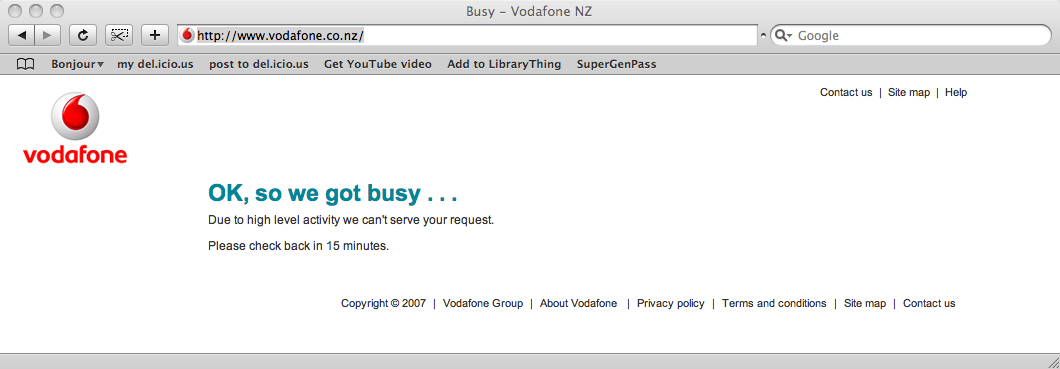
Today, I go to the Vodafone website (because it appears that their DNS servers are dead; thank goodness for OpenDNS) and I get:

Vodafone's home page is down
Vodafone

If an ISP can’t handle serving up their own homepage, are they really a good choice? If you’re a business, would you even consider talking to them at this point?

0759 for the hidden Sky menu

This really falls under the “just so I know where to look next time I forget” category.  With MySky, the “setup” menu is hidden from casual use (IIRC in both UTF Sky and Sky Digital it is not).  To get to it, you go to the system settings menu and type 0759 (0SKY) and then select, and it takes you to the menu where you can change the satellite settings, do a fresh installation, and so on.

When we moved house, the theory was I could just pick up the MySky box and plug it in (there was already a satellite) and save $50.  Unfortunately, this didn’t work.  I was told that I could call their helpdesk and they would be able to help get past the “poor reception” error (which is indeed what I got).  Unfortunately, the technician I spoke to couldn’t do much – in fact she had to put me on hold while she looked up the MySky settings (she started out trying to fix Digital – do they not have an indicator on the customer record that shows I have MySky?) and was clearly reading from a sheet – and a slightly inaccurate sheet at that (it missed a couple of menus, although I knew where to go).

At the end of the day, the tech on the phone couldn’t help.  Although I could again get to the hidden menu, I had forgotten that MySky doesn’t offer a nice simple “choose the satellite” menu – instead you get to enter the frequency and angle yourself, which is information I don’t have.  I’m so busy with work and unpacking that I figured that I’d just not bother trying anything else and let the tech fix it.

It turned out that it was a cable around the wrong way.  However, this isn’t totally my fault – the satellite cable gets split and plugs into the MySky box twice.  One lead is white and one is black.  There are no indicators at all on the MySky box or the splitter that indicates that there is any difference between the two (no #1 and #2 or ‘white’ and ‘black’ or any markings at all).  I’ve unplugged and re-connected MySky many times, and must have luckily picked the same place to plug each cable in, since apparently if you get them the wrong way around you get no signal.

Couldn’t the tech on the phone have mentioned this?  Even just a “try swapping the black and white cables” would have sufficed.  If I’d had more time to play around with things I would have disconnected everything and tried again, and might have randomly selected the right way around, but I didn’t have time for that.  Even suggesting that, though, would have been something.

I guess they really want their $50 moving fee.  For about 5 minutes of technician time.  Bah.

iPhone works fine on prepay

The Vodafone NZ website clearly states that the iPhone (3G) will not be “available” on Prepay.  For various reasons, I swapped the SIMs in my prepay Vodafone phone and our on-contract 3G iPhone last night.  The iPhone worked without any problems at all with the Prepay SIM.

Phone calls and SMS worked fine, as did (as you would expect) all the non-phone features of the phone.  I didn’t sync the phone, so it’s possible it’s disabled there, but that would be easy enough to work around if you had two SIMs as we do (and I doubt it actually is disabled there anyway).  I didn’t try getting data (no plans are available for any Prepay customer, but the casual data is available) since we’re in a non-3G area, but I expect that also works.

Possibly by “available”, they mean “available to buy” – i.e. unless you have a contact with them they won’t sell you one.  However, we bought ours outright and they didn’t even get my phone number IIRC, so they had no idea if I had a contract or not.

I guess they want to sell more contracts, but being honest wouldn’t really hurt that much, would it?  They might even sell more phones, although maybe they don’t make much from that (I’m much more likely to get one if I can stick with my Prepay access).

Hardly news, but: Vodafone NZ sucks

They finally (hard to believe they waited this long) released their iPhone plans (the website is barely up at the moment – they own the second largest ISP in NZ, and can’t handle a bit of load!).

I knew that the data would be expensive here, although I had a little hope when I saw the costs in Australia.  This is much worse than I thought it would be, though.  Are people really going to pay $250 per month?!?  I guess so, but you’re excluding vast numbers of people that would be otherwise interested in this month.

My guess is that the cost is indirectly Apple’s fault.  At the WWDC keynote, Jobs pointed out that the cost around the world would be as low as (or lower than) the new US price – no doubt Apple enforces this in their contracts with the providers.  Vodafone NZ doesn’t want to sell the phone for $199, but has to, so simply raises the contract price until they get what they want out of it anyway.

This is twice as expensive as the US or even the complaining Canadians.  And we have a reasonably decent 3G network, so the phone would have been useful here.

The “250” plan costs $2,619 for 24 months.  For that, you get the phone, 120 minutes, 600 txts, and 250MB of data a month.  I’d pay that, but 120 minutes isn’t enough (we used about 200 minutes last month), and 600 txts are barely enough (580 last month).  It’s the data that breaks the deal – 250MB is about 8MB a day.  IOW, barely enough to check email and use the map occasionally.  My Zabbix status page is about 3MB.  I could check it twice a day.  Ridiculous.

The “500” plan costs $3719 for 24 months, and gives you the phone, 250 minutes, 600 txts, and 500MB of data a month (16MB a day).  Perhaps enough data to use the phone as long as you were really careful and around accessible wifi a lot.  But that’s a big jump in price.

The “1GB” plan (I can’t believe that’s the largest!) costs a whopping $6349 for 24 months (3 and a third brand new iMacs!).  600 minutes, 600 txts, and 1GB of data (32MB a day).  Too many minutes, and still not enough data, although it’d be useable.  But $250 per month?  There’s no way that I can justify spending that, even as a business expense (I would be using it to check the status of servers while out).

A 2GB plan (paying the overage cost) costs $7069 for 24 months.  600 minutes, 600 txts, 2GB for $280 per month.

The other option is to stick with our current plan and add a data pack.  We currently get 60 minutes, 600 txts and also have three “best mates” (unlimited txts, pxts and calls) for $46/month.

With the 200MB data plan added, the cost is $2950.75 for 24 months.  That’s only just more expensive than the iPhone 250 plan, and would suit us much better (the best mates make all the difference).  The difference between 8MB of data a day and 6.45MB of data a day is the difference between barely using the data and barely using the data.

With the 1GB data plan added, the cost is $3430.75 for 24 months.  Less than the iPhone 500 plan!  Twice the data for less money!  What are they thinking?  More importantly, what are the suckers that sign up for this thinking?  Sure you get 120 minutes with the iPhone plan, but we have three best mates that account for vastly more than 60 minutes of call time.  Given that most of the calls and a large proportion of our txts are to those three people, we get better value for exactly the same usage for close to half the price.

So: is it worth another $50 per month (and $1129 upfront) to have the iPhone?  That’s a large chunk of money.  It’s a great device, and we absolutely would use the GPS/mapping/data functionality that our iPod touch lacks.  Lots of thinking in the next couple of days!

A final note: the iPhone itself is $1129, the iPod Touch is $449.  $680 for GPS, calls, txts, and (for lots more money) data while not connected to wifi.  Pretty steep.

Meterage

There was a lengthy discussion on this week’s TWiT about bandwidth metering; the topic was discussed on the Daily Source Code for a few episodes a while back too.  Although Dvorak is often excessively inflammatory and I don’t always agree with what he says, this was a case where he was clearly right and everyone else (well, Leo really did all the talking) is wrong.

The biggest problem is that Leo is confusing two separate issues:

  1. how much you pay for your Internet access, and
  2. do you pay based on how much you use.

These are not the same thing!  Does Leo really think that unlimited Internet usage will stay the same price forever?  If the ISPs want to make more money, they just all put their prices up – they don’t need to muck about with changing how they charge people (which is much more work on their end).

I agree with Dvorak‘s 8 reasons – but it really just comes down to #3 and #4.  I should pay more than my parents do, because I’m using more.

The comparison to water is nice, but very flawed in that there isn’t a lot more that you can do with water.  If I had “all you can drink” water for a single price, would I use more?  Well, maybe a little – I guess people might have baths more than showers, and maybe pool usage would increase.  People might waste less, although I doubt people that avoid wasting water now are really doing it to save a few dollars.  Compare that to unlimited Internet access – there’s really no limit in sight as software gets larger, services move to the ‘cloud’, and audio and especially video online takes over from offline sources.

In the modern economy, are there any resources that are provided (other than those that nature provides) that are not metered?  Over-the-air radio and TV aren’t, but there’s no consumption, either – no matter how many TVs I have receiving an over-the-air signal, the ability of my neighbour to receive the same signal is not effected.  In NZ, local phone calls are unlimited, but that’s enforced for by the government, and from what I understand there’s little effect on my neighbour if I use the phone more (and again, there just isn’t room for much more use – there’s a strict 1440 minute limit per day per phone).

Electricity would perhaps be a better example – there’s an unlimited supply, and much closer to unlimited demand.  (The unlimited supply comes from a willingness to spend money on nuclear/solar/hydro/wind/etc generators, but unlimited Internet access supply comes from spending money on fibre/cables/satellites/etc too).  Is anyone arguing that electricity should be ‘all you can eat’?

Actually, my bandwidth is metered (from TelstraClear) – I’m not sure if there are any other ISPs in New Zealand that offer this.  I pay a base rate (covering overheads) and then a fixed price per 10GB.  There’s no limit to how many GB I can use, but I pay for each.  There are problems here:

  1. it’s not granular enough – it should be 1GB (you can meter in 1GB blocks, but the per-GB price is higher), and
  2. the price is really too high compared to elsewhere in the world.

If those problems were fixed, however, I would still have no problem with metered pricing.

Leo tried to argue that there’s no cost to bits.  While Dvorak argued this, I don’t think it came across just how wrong Leo is.  It doesn’t matter how much peering goes on, somebody eventually has to pay for creating and maintaining the ‘pipes’ that the bits are moved through.  Those pipes have a fixed capacity, which means that there’s limited supply.  If there’s limited supply and limited demand, then the only fair solution is to charge based on the amount that is used.

I’m sure that the a chunk of the motivation on the ISP’s part is to be able to make more money – but they are aiming to make more money by being more fair.  My argument is that the prices are going to rise anyway, so wouldn’t it be better to have things fair now?

Leo is concerned about the viability of services like TWiT Live and Revision3, since if people are paying for bandwidth they will be less likely to use it on Internet video (when over-the-air TV is still free).  I don’t see that as an argument against metered bandwidth, though, but as an argument for lower pricing.  Are people reluctant to turn on the tap to get a drink because that will increase their water bill?  When do you ever hear “Sorry, honey, we can’t watch Lost tonight because the TV will use up extra electricity”?  That’s because the per-unit cost of water and electricity is low enough that people don’t care about using a bit more.

Note that you do get people reducing waste water/electricity.  If you’re not using a tap, you turn it off.  Electronic devices have power-saving features (some people even turn their microwaves off when they aren’t using them, and so on).  But that would be good for the Internet!  What possible benefit is there from me leaving TWiT Live streaming on my computer when I’m not even there?  Does Leo really want to pay (or have sponsors pay) the bandwidth for that sort of wastage?  (This is Dvorak’s reason #8, which seems dubious until you think it through).

What Leo (et al) are arguing is that everyone (or perhaps everyone outside of business) should pay the same price for Internet access, no matter how much they use.  I simply can’t agree with that.