Universal Student Allowances Revisited (verdict: still bad)

Quite some time ago, I wrote a post rebutting the popular idea of a universal (tertiary) student allowance, suggesting a better alternative.  Since the NZ Labour Party has resurrected this terrible idea as their latest election bride (hopefully the NZ public are not stupid enough to fall for the same trick twice…), I figured I would revisit this.  If you don’t want to read all the way through, here’s the take-away point: please do not vote for Labour because you think a universal student allowance would be good for students or New Zealand in general.

Problems with a universal student allowance

The main problem is (still) that it blindly encourages anyone to become a tertiary student, without any consideration of whether they should be.  This is already a problem – somehow a misconception grew that everyone should go to university (or at least a polytech), which led to vast numbers of students unable to manage the academic work, which led to dumbing down of the courses taught.  There’s absolutely nothing wrong with not going to university/polytech – apprenticeships, internships, and other on-the-job style training is vastly superior in many cases.  Other problems include:

  • People who can easily afford to study without any assistance would be given assistance anyway. I can’t see how anyone would think that this would be a good idea.
  • A universal student allowance does little to address the problem with the loan scheme (the allowance is not high enough to remove the need for a loan, unless you have free accommodation).
  • A universal student allowance has no reward for success, either in earlier education, or in tertiary studies. Someone scraping through with C’s gets the same allowance as the straight A student.  I realise that rewarding success is not popular now, but that’s no excuse for making things worse.
  • A universal student allowance does not encourage students to attach value to their education. If students pay for education themselves, then they clearly see that it is valuable, and should not be wasted.  Anyone that has been through the system knows the truth of this problem.
  • The system hurts married couples where the spouse’s income is higher than the threshold, but not high enough to fully support tertiary education for the other partner.  Another example of the Labour government’s hatred for marriage and traditional family systems.
  • Any allowance system will have problems with abatement levels, which are already a problem in New Zealand. I have been in the ludicrous position where I had to ask for lower pay, which meant that I could keep my allowance, or I would have less money in the hand each week. Students are discouraged from working, which is not a good situation, and the system makes it difficult to supplement an allowance income (which is not enough to live off).

A Better Solution

While I firmly believe that a universal student allowance is not the right answer, I do not believe that the current system works well. It is increasingly clear that something needs to be done to fix the system – but it is not clear what that should be. Here is my proposed solution; I believe that not only is it more equitable than both the current system and a universal student allowance, but it is also more practical (which means more likely to gain support from both Labour and National, which is required in order to make a lasting change), and more likely to have a positive long-term effect on the New Zealand tertiary education system.

There are 3 parts to this solution:

  • Allowances. Simple, just get rid of them all. (I suppose you could almost call this a universal student allowance, just one where everyone gets $0.00 per week). This meshes quite well with the NZUSA calls for everyone to be treated equally.
  • Loans. Loans and scholarships (see below) form the backbone of the proposed new system, so need to be well designed, so there are several changes to the nice-idea-but-poorly-implemented existing system (outlined below).
  • Scholarships. My knowledge here is a little out-of-date, but I don’t believe that things have changed all that much since I was a Secondary School student. (See below)

Loans

  • Interest. There’s nothing wrong with getting people to pay for their education, but making money out of them is rather over the top.  However, having no interest at all is just giving the money away. Fix interest at inflation, and continue to write off interest while studying.
  • Accessibility. It’s a loan, not a grant, and you can’t get out of it (by declaring bankcruptcy, for example) except by dying, so there’s no reason to deny people one. Anyone (who is a New Zealand citizen / permanent resident) should be able to get a loan. This means, in particular, that the existing level of study requirements (just dropped to 25%) should be removed – so that someone doing a single paper can get a loan, which is not the case now.
  • Amount available. Maybe once upon a time the amounts were sufficient, but has anyone looked at how much it costs to rent a flat in Auckland these days? Or how much textbooks cost? Every institution should provide StudyLink with a list of approved costs for each paper. These can be claimed without any additional approval required (computers would do all the complicated work, of course). A small additional amount (say $500, inflation adjusted) would be available for miscellaneous expenses like computer equipment, paper, pens, travel, and so on. For any other expenses, (like conference travel for post-graduate students), the student would have to provide a letter, confirming that the cost is course-related, from their institution. The living costs portion of the loan should simply be bumped up, and be bi-annually inflation adjusted. Living costs should also be available year-round, if the student provides evidence that they are enrolled for study in the following year. Sure, all of this means more money given out, but it’s a loan, not free money! Even if people spend it frivolously, it’s their own money that they are wasting, and they’ll have to pay it back at some point.
  • Writing it off. The aim should be to write off a quarter to a third of the total loan amount incurred each year. This allows the government to do the targeting sort of work that it loves to do (and, in some cases, needs to do). For example, you could have $500 wiped off your loan for every year in which you spend at least 300 days in New Zealand. You could have $500 wiped off your loan for every year in which you work in rural New Zealand. You could have $10 wiped off your loan for every hour of work you do for a registered charity (although this would need extremely careful monitoring). You could have $500 wiped off your loan for each year that you serve on a Board of Trustees for a New Zealand school. The list is as long as the list of work that needs doing, but doesn’t have people to do it.
  • Paying it back. In the end, most students should still have to pay a portion of their loan back – as they reap the benefits from it. The repayment rate should be adjusted, however, so that the total payments to the government out of income aren’t too extreme (lower tax rates would also solve this problem). Since there’s only way way (death) to get out of paying it back, there really isn’t any hurry – for the student, or for the government (and the idea is that the education is serving them for life, after all).

Scholarships

  • Whatever the final assessment is at high school, this should have decent scholarships attached to it (The $400 or whatever that I got from an A bursary is not “decent”). For each subject in which a student receives a top grade they should get 1/6th of the average fees for a year’s study. A medium grade would be 1/12th, and other passing grades nothing; truly exceptional grades (back when I was a student a single Scholarship grade meant no money at all) would be 1/3rd. This would mean that a straight A (if ‘A’s existed any more) student would have more-or-less all their fees paid, a straight B student about half, and a student that gained scholarship marks would also have money to go towards living costs.
  • This money should be available for the full length of an undergraduate degree (say 3 years) – in my day you got 2 years, or, if your birthday just happened to be at the right time of year, 3 years.  (It’s possible this has been fixed since my day).
  • The amount of money shouldn’t stay tied to the grades you get in secondary school – it should automatically adjust to your tertiary grades. So a straight A student at high school that drops to straight B’s at uni/tech would only get ~ half their fees paid in year two, the straight B student that gets all A’s at uni/tech gets all their year two fees paid, and so on.
  • The idea here is that those people that are going to do well in their study (regardless of what subjects, their ethnicity, their gender, their socio-economic status, and so on) are helped more than those that perhaps should be considering another area (everyone is good at something, but not everyone is right for tertiary education).
  • This does make it easier for people straight from school than for “mature” students, but I don’t believe that that is a problem. For a start, that’s the way the current situation is. Secondly, we really want to encourage people to complete tertiary education while young (and then carry on with other, unsupported financially, learning later in life). If it really was an issue, then there could be special “mature” scholarship exams.

So what would this cost? When I calculated this several years ago, the total increase in spending was something like $415 million.  I’m sure it’s something similar now (since the loans are interest free already, the costs have probably reduced).  Certainly, compared to the foolish idea of a universal student allowance, it would be acceptable, and provides many other benefits.
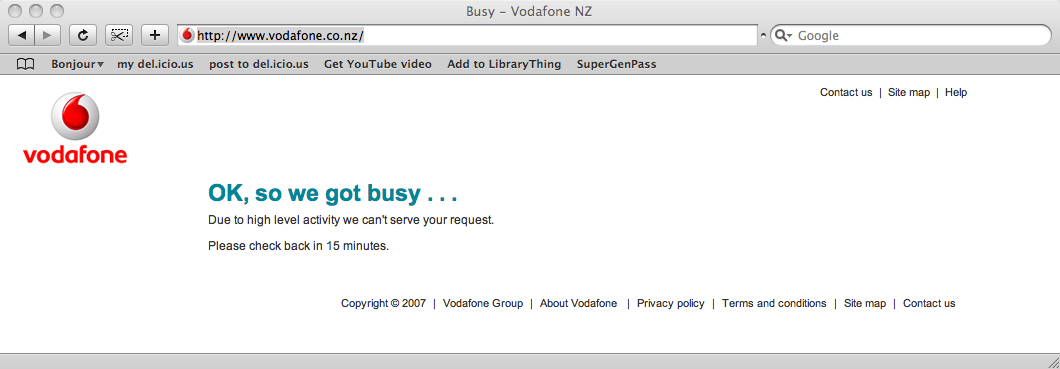
Vodafone subsumes ihug: can’t handle Internet or phone

Vodafone, who I used to think was an ok company, bought and then subsumed ihug, who once was a good company (but had previously sunk to terrible depths). Ihug did all sorts of nutty side ventures, but generally was a company specialising in Internet access and phone calls.

I called Vodafone yesterday, and got a “sorry, we are experiencing high call volume. Please call back” message. And then it hung up! No queue, no way to set up a call from Vodafone back to me to help. Just hanging up on me.

Today, I go to the Vodafone website (because it appears that their DNS servers are dead; thank goodness for OpenDNS) and I get:

Vodafone's home page is down
Vodafone

If an ISP can’t handle serving up their own homepage, are they really a good choice? If you’re a business, would you even consider talking to them at this point?

0759 for the hidden Sky menu

This really falls under the “just so I know where to look next time I forget” category.  With MySky, the “setup” menu is hidden from casual use (IIRC in both UTF Sky and Sky Digital it is not).  To get to it, you go to the system settings menu and type 0759 (0SKY) and then select, and it takes you to the menu where you can change the satellite settings, do a fresh installation, and so on.

When we moved house, the theory was I could just pick up the MySky box and plug it in (there was already a satellite) and save $50.  Unfortunately, this didn’t work.  I was told that I could call their helpdesk and they would be able to help get past the “poor reception” error (which is indeed what I got).  Unfortunately, the technician I spoke to couldn’t do much – in fact she had to put me on hold while she looked up the MySky settings (she started out trying to fix Digital – do they not have an indicator on the customer record that shows I have MySky?) and was clearly reading from a sheet – and a slightly inaccurate sheet at that (it missed a couple of menus, although I knew where to go).

At the end of the day, the tech on the phone couldn’t help.  Although I could again get to the hidden menu, I had forgotten that MySky doesn’t offer a nice simple “choose the satellite” menu – instead you get to enter the frequency and angle yourself, which is information I don’t have.  I’m so busy with work and unpacking that I figured that I’d just not bother trying anything else and let the tech fix it.

It turned out that it was a cable around the wrong way.  However, this isn’t totally my fault – the satellite cable gets split and plugs into the MySky box twice.  One lead is white and one is black.  There are no indicators at all on the MySky box or the splitter that indicates that there is any difference between the two (no #1 and #2 or ‘white’ and ‘black’ or any markings at all).  I’ve unplugged and re-connected MySky many times, and must have luckily picked the same place to plug each cable in, since apparently if you get them the wrong way around you get no signal.

Couldn’t the tech on the phone have mentioned this?  Even just a “try swapping the black and white cables” would have sufficed.  If I’d had more time to play around with things I would have disconnected everything and tried again, and might have randomly selected the right way around, but I didn’t have time for that.  Even suggesting that, though, would have been something.

I guess they really want their $50 moving fee.  For about 5 minutes of technician time.  Bah.

iPhone works fine on prepay

The Vodafone NZ website clearly states that the iPhone (3G) will not be “available” on Prepay.  For various reasons, I swapped the SIMs in my prepay Vodafone phone and our on-contract 3G iPhone last night.  The iPhone worked without any problems at all with the Prepay SIM.

Phone calls and SMS worked fine, as did (as you would expect) all the non-phone features of the phone.  I didn’t sync the phone, so it’s possible it’s disabled there, but that would be easy enough to work around if you had two SIMs as we do (and I doubt it actually is disabled there anyway).  I didn’t try getting data (no plans are available for any Prepay customer, but the casual data is available) since we’re in a non-3G area, but I expect that also works.

Possibly by “available”, they mean “available to buy” – i.e. unless you have a contact with them they won’t sell you one.  However, we bought ours outright and they didn’t even get my phone number IIRC, so they had no idea if I had a contract or not.

I guess they want to sell more contracts, but being honest wouldn’t really hurt that much, would it?  They might even sell more phones, although maybe they don’t make much from that (I’m much more likely to get one if I can stick with my Prepay access).

MacBreak Weekly almost killed me

I’m working away, listening to episode 98 of MacBreak Weekly, and just as I happen to be taking a drink of water, Leo says something humourous in response to Scott (about 1:04:18 in), I involuntarily start to laugh, and start choking.  It was not a pretty sight – the water had to go somewhere.  I’m still coughing.

The show has some reasonable Mac analysis/tips, but it’s really the humour that makes it worth listening to.  Just be careful drinking at the same time!

Hardly news, but: Vodafone NZ sucks

They finally (hard to believe they waited this long) released their iPhone plans (the website is barely up at the moment – they own the second largest ISP in NZ, and can’t handle a bit of load!).

I knew that the data would be expensive here, although I had a little hope when I saw the costs in Australia.  This is much worse than I thought it would be, though.  Are people really going to pay $250 per month?!?  I guess so, but you’re excluding vast numbers of people that would be otherwise interested in this month.

My guess is that the cost is indirectly Apple’s fault.  At the WWDC keynote, Jobs pointed out that the cost around the world would be as low as (or lower than) the new US price – no doubt Apple enforces this in their contracts with the providers.  Vodafone NZ doesn’t want to sell the phone for $199, but has to, so simply raises the contract price until they get what they want out of it anyway.

This is twice as expensive as the US or even the complaining Canadians.  And we have a reasonably decent 3G network, so the phone would have been useful here.

The “250” plan costs $2,619 for 24 months.  For that, you get the phone, 120 minutes, 600 txts, and 250MB of data a month.  I’d pay that, but 120 minutes isn’t enough (we used about 200 minutes last month), and 600 txts are barely enough (580 last month).  It’s the data that breaks the deal – 250MB is about 8MB a day.  IOW, barely enough to check email and use the map occasionally.  My Zabbix status page is about 3MB.  I could check it twice a day.  Ridiculous.

The “500” plan costs $3719 for 24 months, and gives you the phone, 250 minutes, 600 txts, and 500MB of data a month (16MB a day).  Perhaps enough data to use the phone as long as you were really careful and around accessible wifi a lot.  But that’s a big jump in price.

The “1GB” plan (I can’t believe that’s the largest!) costs a whopping $6349 for 24 months (3 and a third brand new iMacs!).  600 minutes, 600 txts, and 1GB of data (32MB a day).  Too many minutes, and still not enough data, although it’d be useable.  But $250 per month?  There’s no way that I can justify spending that, even as a business expense (I would be using it to check the status of servers while out).

A 2GB plan (paying the overage cost) costs $7069 for 24 months.  600 minutes, 600 txts, 2GB for $280 per month.

The other option is to stick with our current plan and add a data pack.  We currently get 60 minutes, 600 txts and also have three “best mates” (unlimited txts, pxts and calls) for $46/month.

With the 200MB data plan added, the cost is $2950.75 for 24 months.  That’s only just more expensive than the iPhone 250 plan, and would suit us much better (the best mates make all the difference).  The difference between 8MB of data a day and 6.45MB of data a day is the difference between barely using the data and barely using the data.

With the 1GB data plan added, the cost is $3430.75 for 24 months.  Less than the iPhone 500 plan!  Twice the data for less money!  What are they thinking?  More importantly, what are the suckers that sign up for this thinking?  Sure you get 120 minutes with the iPhone plan, but we have three best mates that account for vastly more than 60 minutes of call time.  Given that most of the calls and a large proportion of our txts are to those three people, we get better value for exactly the same usage for close to half the price.

So: is it worth another $50 per month (and $1129 upfront) to have the iPhone?  That’s a large chunk of money.  It’s a great device, and we absolutely would use the GPS/mapping/data functionality that our iPod touch lacks.  Lots of thinking in the next couple of days!

A final note: the iPhone itself is $1129, the iPod Touch is $449.  $680 for GPS, calls, txts, and (for lots more money) data while not connected to wifi.  Pretty steep.

Meterage

There was a lengthy discussion on this week’s TWiT about bandwidth metering; the topic was discussed on the Daily Source Code for a few episodes a while back too.  Although Dvorak is often excessively inflammatory and I don’t always agree with what he says, this was a case where he was clearly right and everyone else (well, Leo really did all the talking) is wrong.

The biggest problem is that Leo is confusing two separate issues:

  1. how much you pay for your Internet access, and
  2. do you pay based on how much you use.

These are not the same thing!  Does Leo really think that unlimited Internet usage will stay the same price forever?  If the ISPs want to make more money, they just all put their prices up – they don’t need to muck about with changing how they charge people (which is much more work on their end).

I agree with Dvorak‘s 8 reasons – but it really just comes down to #3 and #4.  I should pay more than my parents do, because I’m using more.

The comparison to water is nice, but very flawed in that there isn’t a lot more that you can do with water.  If I had “all you can drink” water for a single price, would I use more?  Well, maybe a little – I guess people might have baths more than showers, and maybe pool usage would increase.  People might waste less, although I doubt people that avoid wasting water now are really doing it to save a few dollars.  Compare that to unlimited Internet access – there’s really no limit in sight as software gets larger, services move to the ‘cloud’, and audio and especially video online takes over from offline sources.

In the modern economy, are there any resources that are provided (other than those that nature provides) that are not metered?  Over-the-air radio and TV aren’t, but there’s no consumption, either – no matter how many TVs I have receiving an over-the-air signal, the ability of my neighbour to receive the same signal is not effected.  In NZ, local phone calls are unlimited, but that’s enforced for by the government, and from what I understand there’s little effect on my neighbour if I use the phone more (and again, there just isn’t room for much more use – there’s a strict 1440 minute limit per day per phone).

Electricity would perhaps be a better example – there’s an unlimited supply, and much closer to unlimited demand.  (The unlimited supply comes from a willingness to spend money on nuclear/solar/hydro/wind/etc generators, but unlimited Internet access supply comes from spending money on fibre/cables/satellites/etc too).  Is anyone arguing that electricity should be ‘all you can eat’?

Actually, my bandwidth is metered (from TelstraClear) – I’m not sure if there are any other ISPs in New Zealand that offer this.  I pay a base rate (covering overheads) and then a fixed price per 10GB.  There’s no limit to how many GB I can use, but I pay for each.  There are problems here:

  1. it’s not granular enough – it should be 1GB (you can meter in 1GB blocks, but the per-GB price is higher), and
  2. the price is really too high compared to elsewhere in the world.

If those problems were fixed, however, I would still have no problem with metered pricing.

Leo tried to argue that there’s no cost to bits.  While Dvorak argued this, I don’t think it came across just how wrong Leo is.  It doesn’t matter how much peering goes on, somebody eventually has to pay for creating and maintaining the ‘pipes’ that the bits are moved through.  Those pipes have a fixed capacity, which means that there’s limited supply.  If there’s limited supply and limited demand, then the only fair solution is to charge based on the amount that is used.

I’m sure that the a chunk of the motivation on the ISP’s part is to be able to make more money – but they are aiming to make more money by being more fair.  My argument is that the prices are going to rise anyway, so wouldn’t it be better to have things fair now?

Leo is concerned about the viability of services like TWiT Live and Revision3, since if people are paying for bandwidth they will be less likely to use it on Internet video (when over-the-air TV is still free).  I don’t see that as an argument against metered bandwidth, though, but as an argument for lower pricing.  Are people reluctant to turn on the tap to get a drink because that will increase their water bill?  When do you ever hear “Sorry, honey, we can’t watch Lost tonight because the TV will use up extra electricity”?  That’s because the per-unit cost of water and electricity is low enough that people don’t care about using a bit more.

Note that you do get people reducing waste water/electricity.  If you’re not using a tap, you turn it off.  Electronic devices have power-saving features (some people even turn their microwaves off when they aren’t using them, and so on).  But that would be good for the Internet!  What possible benefit is there from me leaving TWiT Live streaming on my computer when I’m not even there?  Does Leo really want to pay (or have sponsors pay) the bandwidth for that sort of wastage?  (This is Dvorak’s reason #8, which seems dubious until you think it through).

What Leo (et al) are arguing is that everyone (or perhaps everyone outside of business) should pay the same price for Internet access, no matter how much they use.  I simply can’t agree with that.

Mahalo Daily Host Search (Follow Up)

Earlier, I gave my opinions about the six potential new co-hosts for Mahalo Daily.  Since then, 3 were eliminated, then another, and now the final winner has been chosen, although who it is will only be announced tomorrow.

In terms of the first elimination, I agree with Jason’s comment that if you don’t turn up you don’t get the job.  Unless there was a last minute family emergency or something like that, then you need to demonstrate a fanatical willingness to do the job to get the job in the first place.  So, although I thought Nadine was the best choice, and Michelle was good, I agreed that eliminating them was the right thing to do.  (From Jason’s comments, it’s obvious that Nadine wouldn’t have got through anyway.  Hopefully she’ll turn up in something else that isn’t MySpace).

Dropping Sarah next was surprising – I expected that Kristina would go first, just based on experience (it really did seem like it would take a while for her to get up to the professional quality that Mahalo Daily seems to be aimed at).  I ranked Sarah last, so that fit with me – she seems to have got something out of the experience, and if she & Lon do start a film podcast, it’s possible I’ll listen to that as well as Filmspotting.

Kristina was obviously going to go before Leah & Andrea.  For all the “dark horse” comments, she clearly was not of the same quality as the others, and while she might well have got there after a while, it doesn’t seem like this is the right place to be learning those skills.

At this point, the “viral video” contest was introduced.  I understand the reasoning behind this – the host does need to be able to be creative and imaginative, and hopefully “think outside the box”.  Producing episodes that actually do spread would obviously also be great, since at least some viewers would start watching regularly.  However, it was certainly a huge challenge – predicting what video will next catch the eye of the Internet masses is basically impossible.  At least they didn’t base the winner on the number of YouTube views or something like that (although it would have been better to let the videos spread for a few days I think).

First to appear was Andrea’s Guitar Hero training video:

This was pretty disappointing, since I would have previously chosen Andrea over Leah.  Problems:


  • Training videos (particularly Rocky-style) have been parodied hundreds of times already.  Another training video parody is extremely unlikely to ‘go viral’, no matter how good it is.
  • There was too much repetition – some really wacky training scenes might have livened it up somewhat.
  • The ending was pretty disappointing.  Jason suggested in the comments that having a guest appearance by Veronica Belmont would have been a good ending, and that indeed would have been great (especially if Veronica was gracious enough to record herself getting slammed by the newcomer).


On the good side, it showed off Andrea well (not just her looks, but the style she would bring), and it was well put together.  Lon was used well, although not great.

Leah’s video was also, unfortunately, a parody, but of a music video:

This was a good video, and clearly much superior to Andrea’s.  There were still problems:

  • It’s another parody.  Aren’t we all done with parodies now?  They are also such an easy choice.  I realise there was a pretty limited timeframe, but making an unusual choice would have been great.  Something really risky (i.e. it might bomb) since Jason made it clear it wasn’t about how popular it was, but about how creative.  If you look at the viral videos that have been successful, many of them are appallingly bad on the surface.  Without thinking about it much, I would have liked something like a fake Mahalo Daily blooper real (pick a dozen of Veronica’s shows and make up semi-realistic but very funny bloopers – perhaps a short guest appearance by Veronica herself), or some wacky science thing (like the Cola+Mentos stuff, or blowing things up – find a crazy science guy and you’ll get some good suggestion), or an original song (original lyrics at least), or some crazily dangerous physical stunt (perhaps looking much more dangerous than it actually was), or a completely over-the-top homage to something odd.  I’m not the creative one, and yet even I wouldn’t have chosen a parody.  The need to feature the contestant themselves (and possibly Lon and Mahalo somehow) did make it more of a challenge.
  • The video shows off Lon’s skills as a comedian (comedienne?) more than Leah’s.  I would absolutely hire Lon based on this, but not necessarily Leah.  There are a few moment where she does shine, but having her a bit more ‘center-stage’ would probably have suited the contest more.  Her acting is also pretty weak, but that hardly matters for a hosting job.
  • Probably it’s just because it’s a parody, but I can’t imagine recommending watching this to anyone, and I have trouble seeing it have a great deal of ‘viral’ success either.
  • Gender-reversal jokes are funny, but they’ve been done to death, and it’s a stretch to take it to two and half minutes.

BTW, I think re-mixing this (is that permissible?) with popup video style additions would make this more humourous.

I think it’s pretty obvious that Leah will win (with a slight chance that both will be hired in some way).  I hope that Andrea goes on to host something else I’m interested in, since I think she’d make a good host (although not good enough to watch something uninteresting!).

Overall, my compliments to all of the contestants, especially the final six.  Despite the fact that I didn’t like them all as potential hosts, getting that far is clearly a remarkable achievement, and they all clearly have enough talent to succeed with something else.

Tekzilla

As suggested by Veronica Belmont herself, I checked out Tekzilla over the last week.  In short: I’ve unsubscribed to the combined feed, but subscribed to the daily tips.

The show seems a lot like something you’d see on TV (or you would if NZ TV had any tech shows).  I don’t enjoy watching those, so it’s not that surprising that I don’t like this (actually, I don’t think I watch any non-fiction on TV at all).  The biggest problem probably is that it seems like it’s aimed at people reasonably unfamiliar with technology.  So overall, if you do like watching TV tech shows, and you’re not all that tech-savvy, I think this would be a good show to watch.

Problems that I had with it:

  • It’s way, way, too long.  It’s two to three times the length of CommandN, which I find too long.  I just don’t have that much eye-time available.
  • I don’t know if it’s a deliberate style choice, or poor editing, or lack of practice, or something else, but seeing Patrick/Veronica change from looking at one camera to another is really irritating.  I would much prefer either a single angle or an edit that changed angle but always had the host looking in the right direction.
  • Q&A style shows don’t interest me much, and it does seem to mostly be Q&A (I did only watch five of the full shows).
  • The quality of the shows on the iTunes feed is terrible.  I’ve subscribed to the HD feed for the short shows, and that’s fine.  I can see that there would be reasons to make the default a low-quality one, but it does give a bad impression first up (especially if you don’t realise that there are other options).
  • As above, the expected audience seems to be people much less familiar with how technology works than I am.  Obviously this isn’t a problem with the show, it’s just a poor match for me.
  • I don’t mind commercials, but the ones they have seem extremely US-centric (do people in the US really not wear seatbelts?  We learnt to “make it click” like 20 years ago!), which is annoying.

That said, I think the hosts are both good (and I do think Veronica is better here than on Mahalo Daily, although I think she’s better still when she guests on TWiT), and the intro & outro are good also (catchy music, short, reasonable graphics).  The daily tips are also pretty good – most are things I already know or aren’t interested in, but they are short enough and well-done enough that I’ll watch 20 of them to get a single useful tip.

There is such a thing as “polite”

In my post rating the potential Mahalo Daily co-hosts, Veronica Belmont herself (presumably!) had this to say:

But on another note, geez… your comments are pretty jerky. These women are trying really hard to make a great show, cut them a little slack. It’s not the easiest thing in the world.

I couldn’t fit a reply nicely in a comment (as always, I am too verbose), and I figured that this was worth a separate post, since it applies to other things I write (and it’s not often that a tiny personal blog like this gets a comment from a celebrity – although if Sarah does win, then I guess it was four times today!).

Before I get to reviewing my own comments (blogging’s highest form, I suppose), comments in general: I don’t feel that it is my place to cut them any slack.  Calacanis asked for ratings with considered thoughts, and that’s what this was.  I have no doubt that it’s a challenging task (if it wasn’t, then they shouldn’t bother), nor that they are all making their best attempt, and I didn’t say either of those things.

When I teach, I give my students honest feedback about what they have done poorly, and what they have done well.  If I sugar-coated my responses (or cut them any slack), then I would be doing them a disfavour, as well as anyone that uses their eventual qualifications (e.g. employers).  It can be abrasive, but it also spurs development and improvement (and in general (but with exceptions) students rate my teaching highly, at least as far as I know).  I expect this feedback from my students, also: either the comments are valid and I endeavour to make changes so that future students benefit from my enhanced skills, or they’re not valid and I don’t worry about them.  I expect, give, and receive, this feedback in other work I do as well.

In the “real world”, people often consider me blunt, abrasive, or rude.  Some people get to know me, and then they realise that, yes, I am (well, not rude).  But it’s never malicious, unconsidered, or untruthful, and reciprocation is always welcome.  I have friends (and a wife of nearly five years), even given this personality trait.

My assumption (could be wrong, of course) is that the comment mostly applies to my comment about Sarah (personally, I think the comments about CommandN and Veronica were the least fair, since I didn’t elaborate on either).  My comments on Nadine, Leah, and Andrea’s episodes were nearly all positive, and the negative was something minor that could be worked on.

My criticism of Michelle – the hair flick is constructive criticism (it should go), the laugh perhaps unfair (but it bothered me personally, and this was a personal response), and I think my feeling about the enthusiasm has the same source as comments from other people about “professionalism”.  I didn’t say that it was fake (that would have been unfair), but that it came across that way.  My guess (personal response, remember) is that she could be more natural and it would be a better show, or that she’s just suited better elsewhere.

My criticism of Kristina echoes that of nearly everyone, including the official judges.  Considering that I’d (probably) watch her in some other show, I can’t see this as “jerky”.

So that leaves Sarah:

Easily the worst.  The comments talk a lot about “energy” (meaningless drivel, really).  There are three problems: (1) the interviewing skills are terrible (evident in the over-editing, if nowhere else), (2) the facial expressions are off-putting, and (3) frankly, she just isn’t ‘hot’ enough – realistically, the show needs an extremely attractive host (especially if co-hosting with Lon) and while Sarah is pretty, she’s not that hot.  Picking a “suck-up” topic doesn’t help.

Personally, the “energy” comments seem more “jerky” to me, since they’re too vague to be of use.  I could have elaborated on the interviewing skills, I suppose, but I already commented on her individual episode (which it’s logical to assume she read).  If I had said her face was off-putting, then that would have been “jerky”, but “facial expressions” is not; to me personally the expressions distracted from the content.

Beauty, as the cliché goes, is in the eye of the beholder.  This is my personal blog, so thankfully I don’t have to prefix IMO to everything I write.  However, IMO Sarah is pretty, but not hot.  Clearly many people disagree with that (possibly including some/all of the official judges).  Commenting on people’s attractiveness is often considered impolite (ironically, more so when the commentee may know of it), but realistically, it’s a huge factor here (and the judges opened the door on such comments in the earlier episodes).  To throw in another cliché, beauty is only skin deep: while I don’t find Sarah attractive, that says nothing about how I find her as a person (again, IMO, but vastly more important).

The topic really did seem chosen to insincerely ingratiate herself with the audience.  Reading her personal blog entry, which  I did after writing my post, it seems a little less so (but the audience can’t be expected to follow her elsewhere).  I think it was a poor choice in that regard.

Was I impolite?  Well, politeness is a cultural thing – I don’t feel I was, but perhaps in the Mahalo Vlog Idol culture, maybe I needed a “sorry Sarah” at the end to make it polite.  I guess the subtitle of this post is then, “but it’s not me”.  Personally, I would consider myself polite, even though (perhaps especially because) I am directly honest.

Bottom-line: if I offended Sarah (or Veronica, or Amber, or whoever is responsible for the quality (or lack thereof) of YouTube videos), then I apologise: such was not my intent.  However, I believe that my comments were appropriate, and not inherently offensive, demeaning, or “jerky”, and accurate (as a reflection on my personal opinion).

Footnote: the title of the post references a tweet from Veronica, which is quite possibly completely unrelated to this, but seemed appropriate.